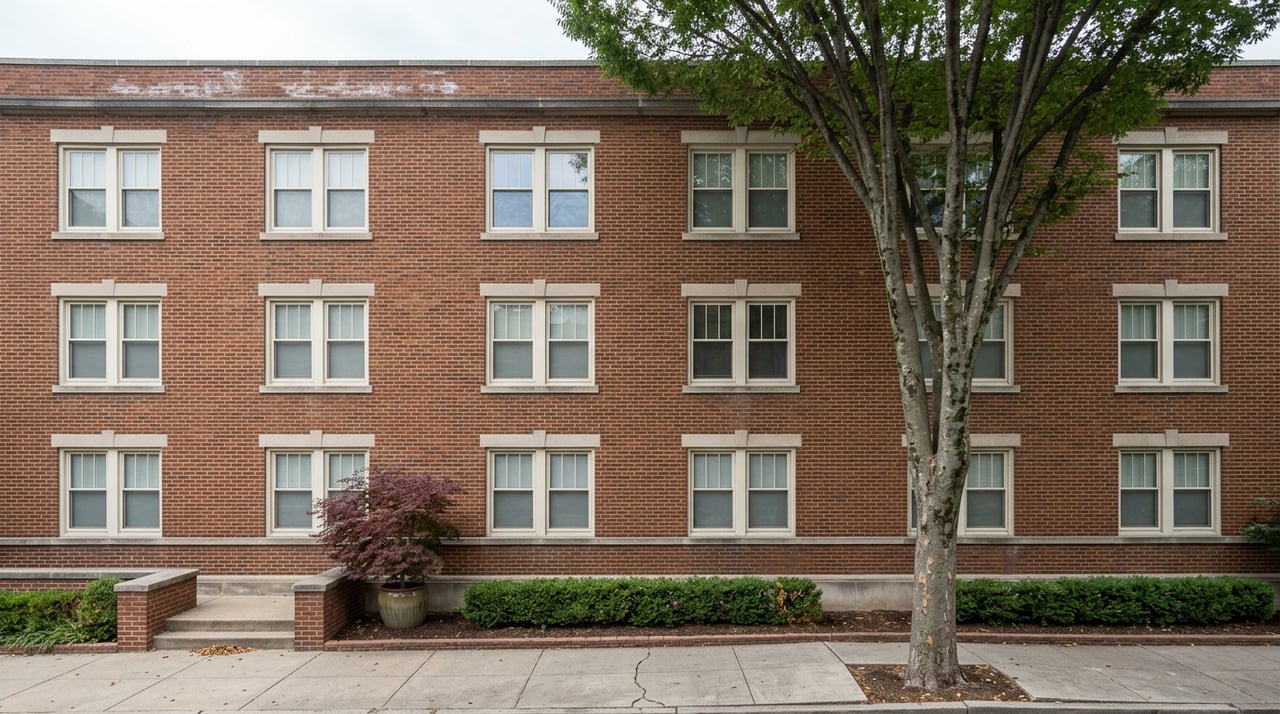
A listing agent working the Port Chester market this year had a habit of writing the same line into remarks: a two-family walk-up near the Rye Brook line, priced at what the agent called Rye Brook value at Port Chester money. Another listing, a mixed-use building with two occupied residential units, leaned on a different fact entirely: five minutes from Greenwich, Connecticut. Neither listing was selling square footage. Both were selling proximity, on the theory that a buyer weighing Port Chester against its neighbors is really weighing a five-minute drive against a price difference measured in hundreds of thousands of dollars.
That theory holds up on the numbers. It falls apart on the explanation most buyers reach for first.
The Gap Nobody Disputes
Port Chester's median sale price has been sitting in the $700,000 to $722,500 range through this year, depending on which tracker you check, with price per square foot running around $451. That's a meaningful jump from a year earlier, but it's still a fraction of what the same commute buys a mile or two east. Zillow's current home value index puts typical Rye Brook homes near $1,009,166, and Greenwich homes near $1,911,058. Cross from Port Chester into Rye Brook and the price roughly climbs by half. Cross into Greenwich proper and it nearly triples.
The easy story writes itself: Port Chester is New York, Greenwich is Connecticut, and Connecticut's Gold Coast commands a premium New York's commuter suburbs don't. It's a clean explanation. It's also wrong in a way that matters if you're the one deciding where to buy.
The Neighborhood That Breaks the Story
Drive from Port Chester into Greenwich and the first neighborhoods you hit, Byram and Glenville, sit at the western edge of town, closer to Port Chester than to the Avenue that defines downtown Greenwich. They carry the same Greenwich mill rate, the same Greenwich school assignment, the same "Connecticut" on the deed as backcountry estates twenty minutes north. And they still price closer to their New York neighbor across the line than to the multi-acre lots and gated waterfront enclaves elsewhere in their own town.
If the state line were doing the pricing work, Byram wouldn't behave like this. A house in Greenwich should command a Greenwich number regardless of which corner of town it sits in. It doesn't, because the line that actually sets price in this corridor isn't a state border. It's a zoning and building-stock legacy that happens to run roughly parallel to that border, then breaks from it the moment you look closely enough.
What's Actually Setting the Price
Port Chester is one of only twelve villages left in New York still operating under its original municipal charter rather than the state's standard Village Law. That distinction traces back to a working past: the village grew as an agricultural port, then a manufacturing center through the mid-20th century, with factories including the Lifesavers plant anchoring it until that facility closed in 1984. Zoning built for a factory town doesn't get quietly rewritten every time the economy around it changes. It stays on the books.
That's why roughly a third of Port Chester's housing stock is two- to four-unit multifamily, why nearly 40 percent of homes predate 1940, and why the village's downtown still reads as dense and mixed-use in a way Rye Brook and Greenwich, both zoned overwhelmingly for single-family lots, simply don't replicate. Byram carries a version of the same legacy on the Connecticut side of the line, a blue-collar settlement pattern that never fully converted to Greenwich's estate-lot zoning even after annexation into one of the wealthiest towns in the country. Same mechanism, different flag.
One Zip Code, Several Markets
If Port Chester priced as a single, coherent market, every data provider tracking it would land in the same neighborhood of numbers. They don't. One current listing-price tracker put Port Chester's median at $314,000 with a $329 per-square-foot figure this September, a fraction of the $700,000-plus median sale prices showing up on trackers built from closed transactions. Recently sold homes in the same zip code have closed as low as roughly $215,000 and as high as roughly $2.4 million.
That spread isn't a data error. It's what you'd expect from a village whose housing stock still includes co-ops and small multifamily buildings from its manufacturing era sitting a few blocks from renovated single-family homes and newer construction. A listing-price median built from what's currently for sale can skew toward the smaller, older end of that mix. A closed-sale median captures whatever actually traded, which this year has leaned toward the higher end of the stock. Neither number is wrong. Neither number describes "Port Chester" as one thing, because it isn't one thing. It's the same stratification playing out inside a single zip code that Greenwich plays out across an entire town.
| Typical home value (current) | What's driving it | |
|---|---|---|
| Port Chester | roughly $607,000 to $722,500 | Mixed multifamily and older single-family stock, charter-era zoning |
| Rye Brook | roughly $1,009,000 | Post-war single-family zoning, larger lots |
| Greenwich (townwide) | roughly $1,911,000 | Includes backcountry estates and waterfront tiers that pull the average up |
Two Projects Testing Whether the Gap Holds
The discount that exists today is not a fixed feature of the map. Two active projects are working on it from opposite directions right now.
The larger one is Westchester Crossing, the redevelopment of the long-vacant former United Hospital site. New York State broke ground on it this year with backing from the Mid-Hudson Momentum Fund, and the plan calls for roughly 957 new housing units, including 105 designated affordable, on a site that had sat unused for decades. Port Chester's certification as a Pro-Housing Community under the state's program helped clear the way for that funding. Adding nearly a thousand units to a village this size is the kind of supply shock that typically puts downward pressure on price growth in the surrounding blocks, at least in the near term, even as it signals long-term confidence in the location.
The second is smaller and aimed at the opposite outcome. The village is partway through building what it calls the Loop, a roughly 1,600-foot pedestrian walkway connecting the waterfront promenade to the MTA train station, the Capitol Theatre, and the Liberty Square retail corridor. Jablko Construction was awarded the waterfront segment this year, and the stated goal is straightforward: make the walk between the train, the theater, and downtown retail pleasant enough that shoppers and diners stick around instead of driving straight through. Walkability improvements like this tend to support price growth on the blocks they touch, even when broader supply is expanding elsewhere in the same village.
Buyers deciding today are essentially betting on which force wins first in their specific pocket of the village: the supply coming online at the old hospital site, or the amenity value building along the waterfront and downtown corridor.
What This Means If You're Comparing Towns
The useful comparison isn't Port Chester versus Greenwich as labels. It's the specific type of housing stock you're buying into. A single-family home on a quarter-acre lot in Port Chester's Tower Hill section is a reasonably direct comparison to a similar lot in Rye Brook. A two- or three-family walk-up in downtown Port Chester has no real Rye Brook or Greenwich equivalent to compare it against, because those towns don't zone for that density in the first place. You're not getting a discount on the same product. You're buying a different product that happens to sit on the same commuter line.
Carrying costs deserve the same scrutiny. Property tax structures differ enough between New York and Connecticut that a raw price comparison misses part of the picture. Several nearby Westchester towns, including Rye and Harrison, run effective tax rates averaging in the neighborhood of 2.5 percent, which changes the real monthly cost of a $1 million Rye Brook purchase in ways a sale price alone won't show you. Before comparing a Port Chester number to a Greenwich or Rye Brook number, run both through what you'd actually carry each month, not just what you'd wire at closing.
FAQ
Is Port Chester in New York or Connecticut? Port Chester is a village in Westchester County, New York, and forms part of the Town of Rye. It borders Greenwich, Connecticut directly to the east, which is why the two markets get compared as often as they do.
Why do some Port Chester listings mention Greenwich or Blind Brook schools? Zip code and school assignment don't always follow the same lines. Pockets of Port Chester sit close enough to neighboring district boundaries that school assignment can shift block by block rather than following the village line as a whole. Anyone comparing listings on school access should check the specific assignment for that address rather than assuming it based on mailing address alone.
Will the Westchester Crossing project change prices right away? Not immediately. The current phase is infrastructure work, roads, utilities, and site preparation, ahead of vertical construction. Effects on nearby comparables typically show up gradually as units come online, not the moment a groundbreaking is announced.
If you're weighing a specific Port Chester block against something in Rye Brook or across the line in Greenwich, the comparison is worth doing property type by property type, not town label by town label. Sunbelt Realty works this exact corridor. Schedule a tour, call or text Juan Carlos today.
